Coyote Information
Description
The name "coyote" (Latin name Canis Iatrans) comes from
the Aztec word coyotl, which is loosely translated as
"trickster". Other names for the animal are brush wolf,
swift wolf, prairie wolf and burrowing dog. The animal
is in close relation to the wolf, fox and domesticated
dog.
The animal has a gray or reddish gray upper coat, with a
white or yellowish undercoat and legs. The course outer
hairs of the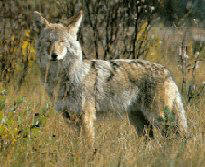 animal can also be black on its tips. The animal can be
from 40-60 inches in length including the tail and can
stand from 15-28 inches tall. The coyote will weigh
between 15 and 50 pounds, depending on the season. The
animal can run at 30 mph for short distances, and can
lope for longer distances at 20 mph. The average
lifespan of the coyote is 8-16 years.
animal can also be black on its tips. The animal can be
from 40-60 inches in length including the tail and can
stand from 15-28 inches tall. The coyote will weigh
between 15 and 50 pounds, depending on the season. The
animal can run at 30 mph for short distances, and can
lope for longer distances at 20 mph. The average
lifespan of the coyote is 8-16 years.
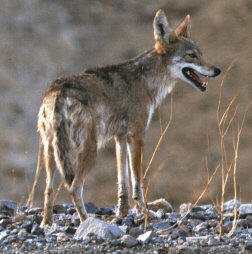
The coyote has stout erect ears and a narrow snout. Its
tail is very bushy and is kept lower than the plane of
the back, and sometimes between its legs, unlike most
domesticated dogs. It will become very bushy and will be
held horizontal when it displays aggression. Its eyes
are usually an arresting yellowish color.
The animal vocalizes in many ways. Most people are
familiar with the characteristic cry that can be heard
for miles. Coyotes are also known to yelp and bark like
domesticated dogs in communicating with each other. The
coyote also commonly "huffs" when communicating with its
pups so as not to make a great deal of noise.
Background
The coyote was first found mainly in the northwest comer
of North America. It has now been found in the entire
continental United
 States,
and can be found from Atlantic to Pacific from Northern
Alaska to Panama. When European settlers began their
expanse across America, they began to change the
landscape of the continent and thereby the territories
of the coyote. Also, these settlers drove out and killed
large populations of the wolf, which had been keeping
the coyote numbers in check. Without the presence of the
wolf, the coyote numbers expanded. States,
and can be found from Atlantic to Pacific from Northern
Alaska to Panama. When European settlers began their
expanse across America, they began to change the
landscape of the continent and thereby the territories
of the coyote. Also, these settlers drove out and killed
large populations of the wolf, which had been keeping
the coyote numbers in check. Without the presence of the
wolf, the coyote numbers expanded.
The coyote is a very adaptable animal. It can change its
breeding habits, diet and social dynamics to fit its
current situation. The animal can adapt to any terrain
and climate. Coyotes can survive in urban areas as long
as there is food, water and shelter available.
In Illinois, coyotes are more abundant in the southern
and west central parts of the state. Coyotes were rare
in Illinois for a time after the first settlement of the
state, but their count has increased dramatically over
the past 3-4 decades. They are more abundant in areas
with a mixture of farmland, woodland and grasslands.
Habitat
The coyote lives in a large territory sometimes from
10-40 miles in diameter that is largely determined by
the amount of food available on the site. The coyote
marks its territory with urine signposts as most canines
do and by its patrol of the area. Sometimes territories
overlap with other coyotes, but generally the coyote
families do not mix. The territory always has a water
source in its area. Water sources can be rivers, ponds,
and water hazards for golf courses or even swimming
pools.
The den of the coyote can be based in a woodpile, rock
or cave foundation or abandoned building. Generally,
however, the coyote burrows a hole near a tree, stump or
large rock. Also, the animal has been known to drive out
smaller animals, such as foxes or badgers, from their
dens, enlarge the hole and utilize these grounds. The
coyote uses the den primarily for the shelter of its
young. Coyotes usually sleep outside with little to no
shelter.
Breeding
The coyote has been determined to be mostly monogamous.
The coyote begins its mating season from January to
March. Males and females both share responsibility in
the raising of the pups. Males provide more of the
security and food for the family, while the mother will
bring in some food and nurture the young. Gestation time
for the female is usually 63 days and the pups are born
in April or May. Young females (about 1 year old) have
smaller litters, around 3-6 pups. Mature coyotes can
have litters of 4-9 pups. The pups are born blind and
open their eyes after about 8 days. The female nurses
the pups for the first 2 months. After about 3 weeks,
the young begin to eat food regurgitated by the mother
and father, in an effort to wean the pup from the
nursing to more solid foods. The young first come out of
the den after around 3 weeks, but are not allowed to
remain outside for long periods of time. At 5 or 6 weeks
the pups are allowed outside more and are taught to hunt
small animals at this time. The family moves out from
the den after 3-4 months that is in the late summer or
early fall. Gradually the family begins to break up.
After the pups leave their parents, the pups may move up
to 120 miles in search of their own living space.
Crosses between coyotes and feral dogs can occur. Their
offspring are called "coy dogs". Coy-dog reproduction is
very poor because the coyote dogs breed in November,
which culminates in mid-winter births. Also, the male
coy-dogs do not bring food for the females after the
birthing and do not help the female to raise the young.
Diet
Coyotes, while classified as carnivorous, are really
omnivorous. The main diet for the animal is small
mammals, but they often feed on insects, birds, eggs,
fish, fruits and berries. In Illinois, rabbits and mice
comprise the bulk of the diet for the coyote.
The coyote is a cunning and opportunistic predator. It
will utilize a variety of hunting techniques. While some
coyotes have been known to hunt in packs to bring down
large animals such as deer, in Illinois the coyote
usually hunts alone or in pairs for the small animals
that they feed upon. The coyote almost always hunts at
night, but have been known to come out in the day to
capture squirrels and other non-nocturnal animals. The
animal will track its prey for 20-30 minutes using its
excellent sense of smell.
Farmers have legitimate concerns on the coyote. The
animal has been known to infiltrate the farm and cause
substantial damage to the livestock. Coyotes feeding on
livestock are not as common. The causes for these
attacks depend a great deal on the coyote population in
the area as well the availability of other foods.
Fertile farmlands usually contain an abundance of small
game, and the need to feed on populated farms is
reduced.
Public Concerns
Without question, there is no other wild animal in North
America whom humans have tried so hard to eradicate.
However, the animal has been remarkably resistant to
these efforts. Most people live in areas populated by
coyotes without ever knowing it. Coyotes are generally
fearful of humans and will take great measures to avoid
contact. However, people are alarmed when the coyote is
spotted, especially during the day. As was previously
stated, the coyote is generally out in the day only when
it needs to feed on specific prey that is out in the
daylight.
The larger concern is for persons who let their small
dogs or cats run loose, especially at night. Coyotes
almost certainly do humans more good than harm. They
keep a natural balance between animals such as squirrels
and mice and the landscapes and agricultural fields that
humans seem to protect. All this good, however,
immediately dissipates when a coyote eats the occasional
cat or dog.
The coyote is also susceptible to a range of diseases
just like the domesticated dog. Rabies, distemper and
mange are the most predominant diseases that can be
transferred to the dog or cat. The animal can also carry
fleas and ticks, which can transfer other diseases such
as Lyme Disease to humans.
A wild coyote is almost always a timid animal with a
natural fear of humans. They are curious animals and may
watch a human from a distance and are likely to run away
before they are seen. Coyotes in cities and urban areas
however may be accustomed to the scent of humans and may
not be quick to run. These animals are often the feeders
of improperly stored garbage or the food that has been
left out for domesticated or wild animals. In some
cases, neighbors have been known to feed the animal, and
it will think that all humans will provide a food source
for it.
Solutions
What most people need to realize is that the presence of
the coyote in America is inevitable and can be quite
necessary. Without these natural predators, rabbits,
squirrels, mice and other small rodents would quickly
overrun our lands. In general, there is no need to
control the population of the coyote.
When a specific problem with coyotes occurs, the
situation needs to be dealt with directly. Many farmers
used to kill all coyotes seen, but have begun to capture
the specific animal when damage has been done. The idea
of removing the offending animal and leaving the rest
unmolested actually helps the farmer. The strategy
recognizes that it is better to leave other coyotes
alone so that they may warn other coyotes coming into
the area that may be livestock killers. The farmers also
realize the affect that the coyote has on the mouse and
rabbit populations. The same can be said for suburbia.
Removing the single animal that may have attacked a pet
or human can send a message to the other coyotes in the
area to fear the human.
What people can do to keep their area free of coyotes is
to recognize what their actions can cause upon the
environment. Garbage should be kept in tight containers
and should not be put out until the morning of pickup.
This is good not only for coyotes, but it helps to keep
skunks and raccoons from becoming a problem. When
especially attractive food wastes like chicken or fish
are bagged, a small amount of ammonia can be added to
the bag to mask the scent and simulate the scent of
another animal that may mark its territory. When it will
be several days before pickup, freezing the wastes until
the pickup is preferred.
Next, wild animals should not be fed. Feeding any wild
animal creates a chain of events that can cause many
problems. Bird feeders can cause birds to not naturally
migrate, or to not look for food that may be medically
necessary for their survival when they do migrate. Also,
the feed spilled by the birds will attract smaller
mammals such as squirrels, raccoons and skunks. Coyotes
and other predators will recognize these hunting grounds
and return frequently. Food that is left out for
domesticated pets is also something that coyotes and
other animals will search for.
Thirdly, people need to remember not to leave pets out
at night. Coyotes can be serious predators to cats, dogs
and other caged animals. Leaving the pet out at night
also means that there is a food and water source for the
animal and its predator. Poultry and pet livestock
should be properly confined in well-built cages or pens.
Finally, the coyote should never be fed purposely. When
a coyote is allowed to interact with humans, their
natural fear of the humans diminishes. This means not
only are the coyotes likely come further into yards and
near homes, but also it can send a signal to other
coyotes that may not be as tame that the neighborhood is
fine for hunting.
In conclusion, it is best for all of mankind to allow
the natural presence of coyotes in the wild; humans must
take steps to discourage the coyote’s migration into the
neighborhoods. With the expansion of humans into their
open lands, the coyote's hunting territories are
diminishing. The coyote will naturally move to new
territories that are ripe for hunting. If they are
finding a food source in our neighborhoods, they will
not leave the area and will instead become more
socialized to human beings. Reducing the amount of land
will drive small mammals and rodents into the
neighborhoods, and thereby causing the coyote to move in
as well.
The presence of the coyote in rural America is necessary
to keep the mouse and other varmint population to a
minimum. By not allowing the coyote to feed in
neighborhoods, it will concentrate its feeding on pests
in the grasslands and other open areas, thereby not
allowing the pest population to overrun into the
neighborhoods. Educating the public is the only way to
keep a natural balance to the environment
Recommendations
The Illinois Department of Natural Resources has
provided the following recommendations:
-
Do not feed
coyotes
-
Limit
availability of unintentional food sources (trash,
bird food, pet food, ripe fruit, etc.)
-
Comply with
ordinances that require oversight/restraint of pets
-
Recognize that
coyotes are a permanent fixture in urban/suburban
landscapes seeing one cross your backyard doesn't
necessarily constitute a problem
-
Recognize that
population reduction (removing all of the coyotes in
an area) is usually unrealistic and always
temporary.
Resources
Illinois Department of Natural Resources
Illinois Natural History Survey
Humane Society of the United States
|
| |
|
|
